
Capital
Bring resources into the enterprise and direct their use.
A practical framework for designing the enterprise behind the idea. Explore how capital, entity structure, ownership, governance, organization, operations, and finance work together to support an enduring institution.
Every enduring enterprise begins with intentional architecture.
A product can attract customers. Capital can fund growth. Skilled people can accomplish remarkable work. Yet the company can still be fragile when ownership is informal, authority is unclear, operations depend on a founder, or financial controls lag behind growth.
The enterprise needs a structure that can carry its ambition.
An enterprise is a system of systems. Each domain has its own job; the design works when their decisions fit together.
Bring resources into the enterprise and direct their use.
Establish the legal structure through which the enterprise acts and evolves.
Define economic interests, rights, and responsibilities.
Assign authority, decision rights, oversight, and accountability.
Structure people, roles, functions, and reporting relationships.
Turn capability into repeatable execution.
Plan, measure, protect, and allocate financial resources.
Sustainability is the foundation. Scalability is the result.
Explore the ArchitectureLegal structure, capital, leadership, operations, and finance are often studied as separate subjects. In practice, every decision affects the same enterprise. The book helps readers understand the connections and the order in which foundational decisions must be made.
Eight chapters move from the enterprise’s foundations to its ability to function through clear authority, coordinated people, repeatable processes, and disciplined finance.
Operational readiness is the point at which foundational systems are sufficiently designed and integrated to support greater complexity.
Understand why the systems exist, how they interact, and what problems they are meant to solve.
Own a book in the Architecture of a Startup Company series? Use the QR code or registration URL printed in that book to connect its Book Vault privileges to your account.
Each book activates only the access rights associated with that title.
Registration InstructionsYou do not need to own a book to create an account. Create one to explore available books, Training & Certification, products, and other offerings.
A free account does not by itself activate Book Vault privileges for any book.
Create Free AccountExplore the book’s integrated framework, its seven architectural domains, and the path from an entrepreneurial concept to operational readiness.
Designing the Enterprise: From Conception to Operational Readiness
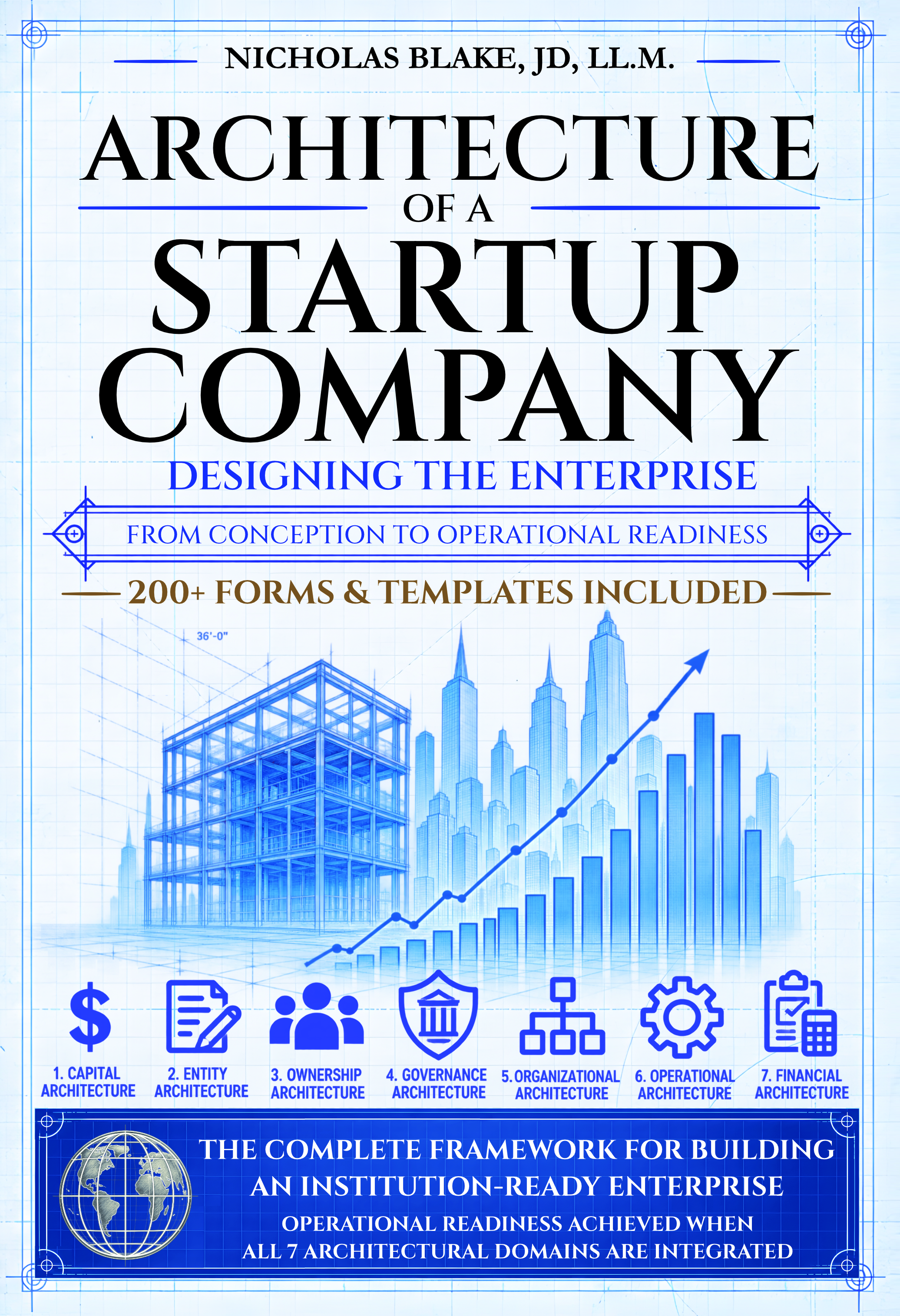
Architecture of a Startup Company — Book I: Designing the Enterprise: From Conception to Operational Readiness presents a systematic framework for transforming an entrepreneurial concept into a sustainable, scalable, and institutionally capable enterprise. Through an included QR code, readers gain access to the online Book Vault, featuring hundreds of downloadable forms, templates, checklists, worksheets, and practical implementation resources designed to complement the book's eight chapters, reinforce its foundational principles, and help readers translate enterprise architecture from theory into practical application.
Rather than treating business formation as a collection of independent legal, financial, managerial, and operational tasks, the book approaches the startup as an integrated system that must be intentionally designed. It introduces seven interconnected domains of architectural sustainability: Capital Architecture, Entity Architecture, Ownership Architecture, Governance Architecture, Organizational Architecture, Operational Architecture, and Financial Architecture.
Beginning with the distinction between an idea and a viable business, the book examines how founders can establish an appropriate legal entity, allocate ownership, align founder interests, design decision authority and accountability, implement governance within LLCs and corporations, structure the organization for execution, develop repeatable operational systems, and create the financial disciplines necessary to support sustainable growth.
Throughout the book, architectural models, principles, diagrams, case studies, and practical frameworks illustrate how seemingly independent business decisions interact across the enterprise. Particular attention is given to founder alignment, ownership and control, delegated authority, institutional accountability, decision architecture, organizational design, operational resilience, institutional memory, scalability, financial governance, capital allocation, budgeting, forecasting, treasury, banking, cash management, and internal financial controls.
The central premise is that successful enterprises must gradually transform capabilities that initially reside within their founders into systems that belong to the institution itself. The destination is Operational Readiness: the point at which the foundational systems of the enterprise have been sufficiently designed, integrated, and institutionalized to support increasing organizational complexity and future growth.
Written for entrepreneurs, founders, business owners, executives, advisors, students, and professionals involved in building emerging companies, Architecture of a Startup Company provides both a conceptual framework and a practical roadmap for designing the enterprise before growth tests the architecture upon which it depends.
Book I · Optional Advanced Resources
No resource library can guarantee success. But intentional architecture, supported by practical working tools, helps transform important decisions into documented, reviewable systems. The book teaches the architecture. The Advanced Resources help put it to work.
Explore a coordinated library of editable agreements, governance instruments, ownership and financial models, organizational and operational workbooks, implementation guides, review schedules, and supporting figures across Book I’s eight chapters.
Separate purchase; eligible Book I Standard registration required. Download counts include available file formats and supplementary figures, not that many different original works. Educational implementation materials are not a substitute for legal, tax, accounting, financial, or other professional advice. Access and use are subject to the applicable terms.
Learn what the Book Vault contains, why an account is useful, and how book registration and purchases determine access.
Your Personal Gateway to Books, Resources, and Educational Products
The Book Vault is the secure online account and resource center for Architecture of a Startup Company, its companion publications, and the educational resources and products offered through Blake Publishing.
Rather than treating each book, resource collection, purchase, or educational offering as a separate transaction, the Book Vault provides a centralized location where registered users can manage their accounts, connect eligible purchases, and access the materials available to them.
Creating a Book Vault account is free. You do not need to purchase or own a book to create an account.
Your Account and Registration Information
Maintain your account credentials and contact information, register eligible books, and associate your purchases and resource-access privileges with a single account.
Book Resources and Companion Materials
Access the downloadable forms, templates, worksheets, checklists, reference materials, and other educational resources associated with your registered books. Resources are organized by book, chapter, and subject matter to complement the material presented in each publication.
Advanced Resource Collections
Explore expanded implementation packages, document libraries, financial models, governance instruments, and other specialized resources. Advanced collections are separately offered and become accessible when the applicable purchase and authorization requirements have been satisfied.
Orders, Purchases, and Access Records
Access available information concerning your purchases, order confirmations, payment records or receipts, and the digital products associated with your account. Certain transactions may be processed through external payment providers, and the availability of particular records depends on the applicable transaction and account features.
Training, Certification, and Educational Resources
Explore educational programs, training opportunities, certification information, and related learning materials available through the publishing platform. Account registration provides a common starting point for participating in offerings that may require separate enrollment, qualification, or purchase.
Your Book Vault account provides a continuing connection between you and the books, resources, and educational products you acquire.
For example, when you purchase a qualifying edition of Architecture of a Startup Company, the book's registration instructions allow you to associate that publication with your account. Once the registration is validated, the corresponding Book Vault resources become available under the applicable access permissions.
As additional books and eligible products become available, they can be associated with the same account without requiring a separate user identity for each publication.
Creating an account does not automatically provide access to every book, downloadable resource, Advanced collection, or paid educational offering.
Access is determined by the products you register or purchase, the educational programs for which you enroll, and the permissions associated with your account.
One account. Multiple publications. Resources organized around your participation.
Create your free account to establish your place in the Book Vault. Register a book or acquire an eligible product whenever you are ready.
Design the company behind the product.
Identify structural weaknesses before growth magnifies them.
See how specialized decisions affect the whole enterprise.
Assess whether an enterprise can responsibly absorb capital and complexity.
Explore the institutional course and download its flyer and syllabus without an account. Read about Training & Certification without an account; registration is needed only to enroll and use protected course features.

Nicholas Blake brings an interdisciplinary perspective spanning engineering, business operations, governance, project management, process improvement, and legal education. His work examines how a promising venture becomes an institution with clear authority, accountable people, repeatable execution, and financial discipline.
Start with Book I. Then turn its framework into practice through the companion Book Vault.